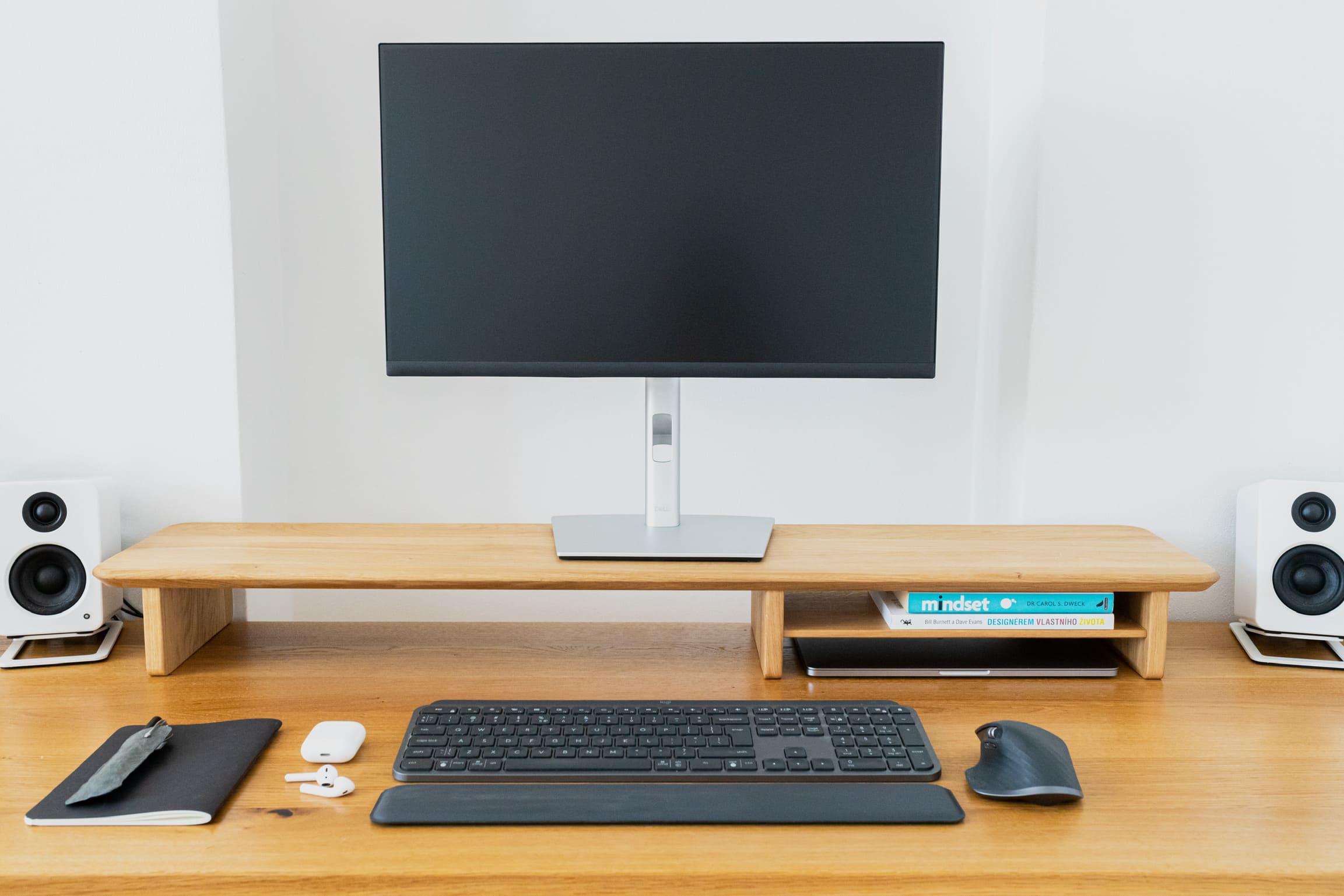
Grindwood started with a very ordinary observation: people spend a large part of their lives at desks, but many workspaces are assembled almost accidentally. A laptop arrives, then a monitor, then another monitor, chargers, notebooks and cables. The desk becomes functional, but not necessarily considered.
We wanted to make one object that improves that space without adding more technological complexity. A solid-oak monitor stand was a natural place to begin.
Useful before decorative
The first requirement is simple: the object needs to earn the space it occupies. The stand raises screens, creates storage underneath and gives a wide monitor setup a visual foundation. If it did none of those things, beautiful wood would not be enough.
We are interested in design that is visually calm because the function is clear, not because every object has been stripped of personality.
Real materials
Grindwood's name combines the work of shaping and finishing wood with the reality of the material itself. We like surfaces that reveal what they are made from. That is why the first product uses solid European oak rather than a printed wood effect.
Natural material also forces a different relationship with consistency. Grain and tone vary. You cannot make every stand optically identical without removing some of the reason for choosing wood in the first place.
Stay close to production
The stand is made in Czechia. For a small brand, that keeps product development close enough to inspect physically and discuss directly with the people making it. We value that proximity more than the marketing phrase “local production.”
The aim is to understand the object well enough that improvements come from contact with the product rather than from distant specifications.
Better work is broader than furniture
A monitor stand can change screen height and desk organization. It cannot teach someone how to focus, create a healthy routine or make a stressful job meaningful. That is exactly why Grindwood should not become a website that only talks about buying a monitor stand.
The Journal exists to explore the broader context: workstation ergonomics, attention, mindfulness, materials, light, sound, routines and the design of spaces where people spend focused time.
Some of that content will relate directly to products. Much of it should remain useful even if you never buy anything from us.
Build slowly enough to keep a point of view
There is an obvious temptation for a young brand to add products quickly. We would rather expand around a coherent idea: objects that improve the experience of working at a desk without making the desk busier.
That could eventually mean different sizes, other materials or entirely different workspace objects. The exact catalogue can change. The principles should be harder to move: useful function, considered design, honest materials, responsible production and content that treats the customer as a person rather than a conversion rate.
Grindwood as a working idea
We are early. That means the brand is still being shaped by the people who use the product, the things that work and the things that do not. We would rather acknowledge that than pretend the story arrived fully formed.
For now, Grindwood is one carefully made object and a growing body of ideas about making the place where we work a little better.