Environmental claims often collapse a complicated product into one reassuring adjective: sustainable, natural, green or responsible. Those words can be useful, but only when they point to something concrete.
For a piece of workspace furniture, we think it is more useful to examine a handful of practical questions than to pretend there is a single sustainability score.
What is the product actually made from?
Material choice matters because different materials carry different extraction, processing, transport and end-of-life impacts. Natural does not automatically mean low-impact, and synthetic does not automatically mean irresponsible. The useful question is whether the chosen material makes sense for the function and expected lifespan of the object.
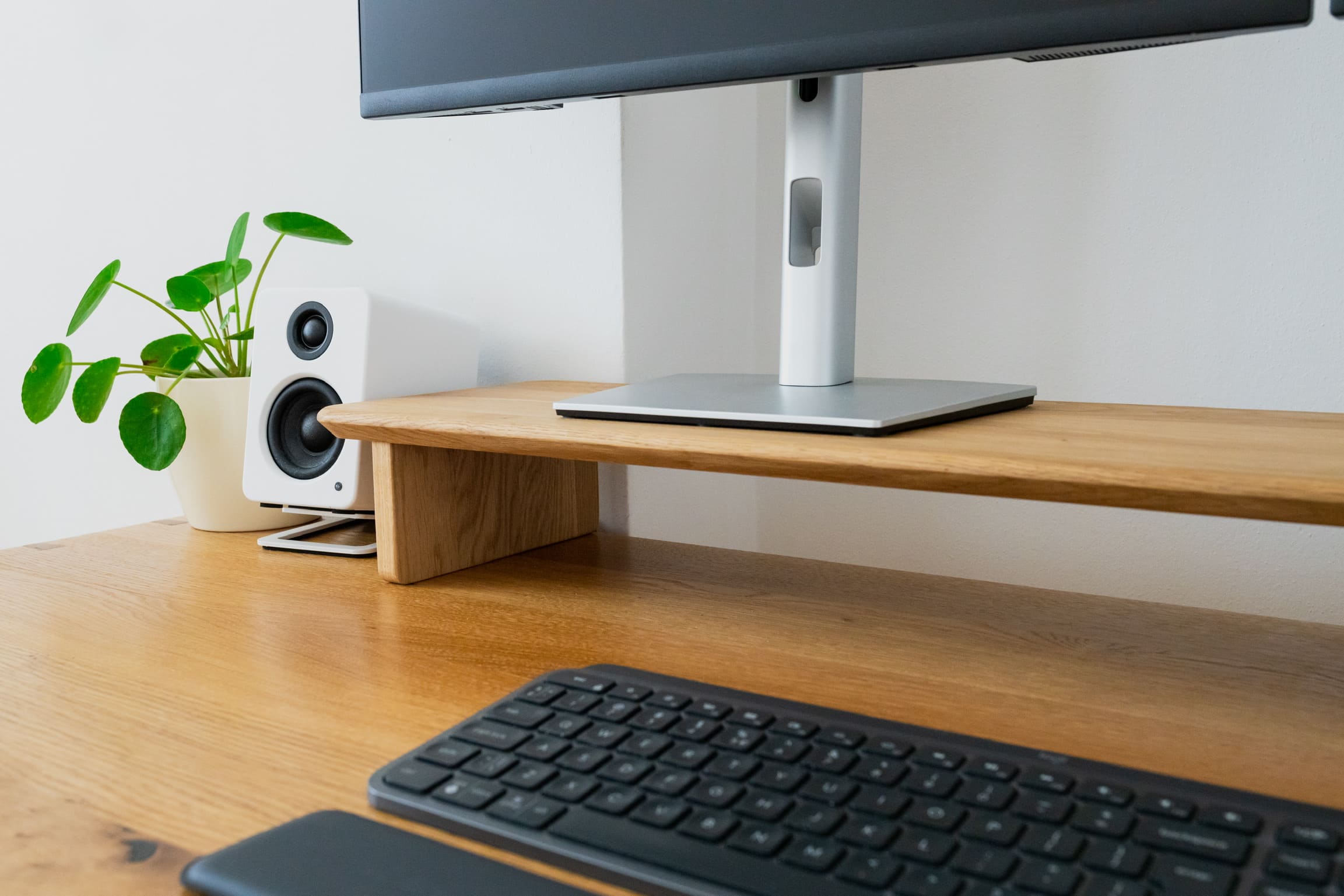
Grindwood uses solid European oak for the monitor stand. We value its durability, repairability and the fact that the product does not need a decorative imitation layer to look like wood.
Where does the material come from?
Wood is renewable only when forests are managed so that harvesting does not simply become depletion. Our approach is to source from managed, certified forestry and to keep the origin of the material as traceable as practical for a small brand.
Certification is not a substitute for asking questions, but it creates a more useful baseline than an unsupported statement that a material is “green.”
How long will the object remain useful?
Durability is one of the least glamorous environmental qualities. A product that stays useful for many years can reduce the frequency with which materials, manufacturing and transport need to be repeated.
That is one reason we prefer solid wood and a simple construction. The product is not dependent on software, batteries or a proprietary mechanism that can become obsolete. Its job is straightforward enough that it should remain understandable years from now.
Can the product age without immediately becoming waste?
Some materials look perfect until the surface fails, then become difficult to restore. Solid wood can show wear more gradually. Marks can often be treated, surfaces can be refreshed and a change in colour does not necessarily make the object unusable.
That does not mean every wooden product will be repaired instead of replaced. It means the material gives the owner more options.
How far does the product travel, and how is it packaged?
Transport is only one part of a product's footprint, but it is still a part. Manufacturing in Czechia and selling primarily into Europe keeps the production and main customer market within the same region. Packaging should protect the product adequately without turning unboxing into an exercise in disposable material.
Responsible consumption also means buying less
This is the uncomfortable part for any brand selling objects. The most responsible purchase is often the one you do not need to make.
We would rather Grindwood earn a place on the desk through long-term usefulness than encourage constant upgrades. The goal should be to make something worth choosing carefully and then living with for a long time.
Environmental responsibility is not a finished badge for us. It is a set of decisions we should be able to explain, measure more carefully over time and improve as the company grows.